
New Orleans was laid out in 1718 on a bend of the Mississippi, and it still asks visitors to slow down. Lunch runs long, music starts late, and ten blocks can take an hour. The New Orleans City Guide is built for that pace: it reads the city in six territories, from Audubon Park to the Bywater, and says for each one where to sleep, where to eat and what to hear after dark.
The 2026 edition runs to 109 plates. Inside: 106 numbered addresses, 20 maps, 30 illustrations and three itineraries. It opens in the browser, with nothing to install, and it is free.

Six territories, one base map
The guide opens with the spirit of the place, ten facts to set the city before choosing a hotel, the seasons, how to get there and around, and the local codes. Some of those facts change a budget: since January 2025 the standard combined sales tax in New Orleans is 10%, and a hotel room in Orleans Parish carries more than 16% in taxes, plus a flat nightly fee. A rate that looks reasonable online can gain a sixth by checkout.
Then comes the territory. The French Quarter holds 29 of the 106 addresses, the CBD and Warehouse District 23, the Garden District and Uptown 22, the Marigny and Bywater 11, Mid-City and Bayou St. John 8, and Tremé 4. Eight more lie outside the city, for the day trips. Each territory gets its own pages: what it is like, who it suits, and whether it is worth sleeping in or better reached by streetcar for an afternoon.
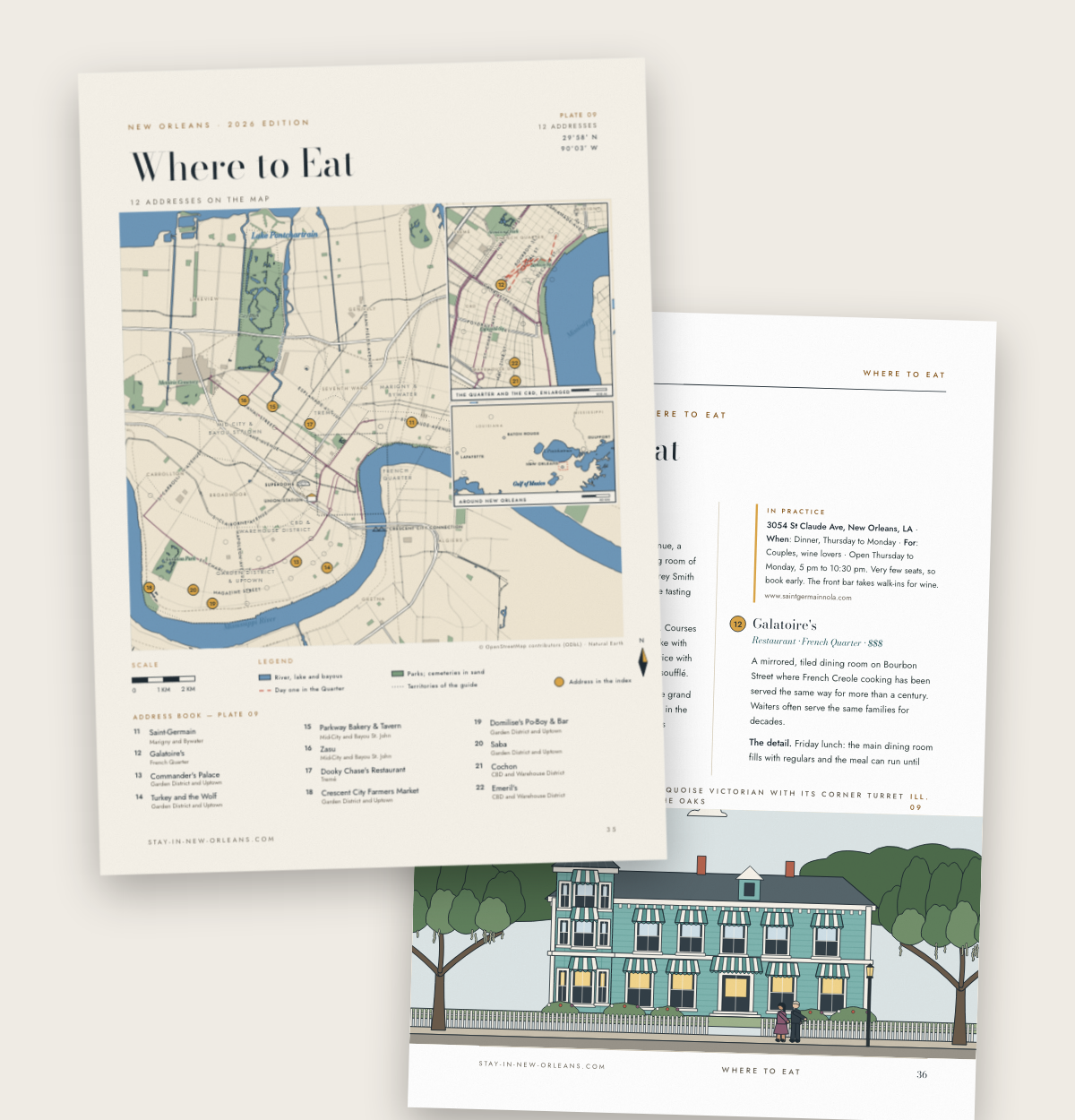
Every map is drawn on the same base: same extent, same scale, the same bend of the river, the same streetcar lines, with two insets for the French Quarter and the CBD and for the region around the city. Only the addresses lit in gold change from one plate to the next, numbered as in the index.
Thirteen chapters of addresses
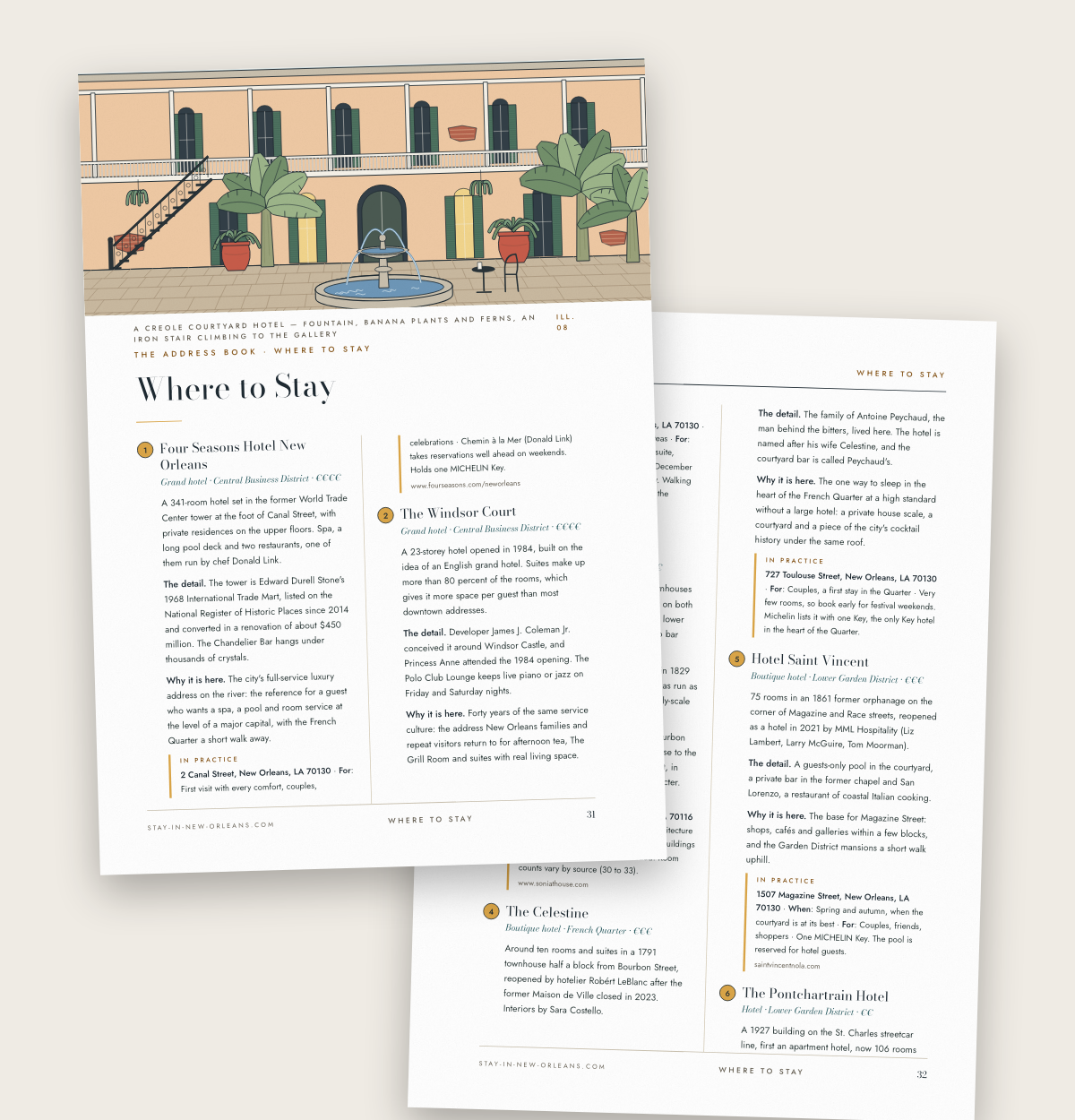
The address book is the heart of the guide. Each entry carries its number on the map of its chapter, its category and its neighbourhood, what sets it apart, why it is in the book, and a practical line: where, when, for whom.
Where to Stay keeps ten hotels that are part of the city's story rather than a base outside it. Soniat House sits on the quiet residential end of Chartres Street. The Windsor Court, opened in 1984 on the idea of an English grand hotel, gives more than 80 percent of its rooms over to suites. Hotel Saint Vincent occupies an 1861 former orphanage on Magazine Street. The Four Seasons fills the former World Trade Center tower at the foot of Canal Street.
Where to Eat lists twelve tables, from the mirrored dining room of Galatoire's on Bourbon Street to Saint-Germain in the Bywater, a storefront with about twelve seats and one Michelin star, where two chefs cook a ten-course menu that changes with the season. Dooky Chase's Restaurant, opened in Tremé in 1941, and Parkway Bakery & Tavern in Mid-City are there too.
After Dark keeps seven rooms for music, among them Preservation Hall and the Maple Leaf Bar on Oak Street, where bands have played seven nights a week since 1974. Where to Drink, Coffee and Early Hours, Shopping, Culture and Heritage, Outdoors, Wellness and Experiences follow, then The Calendar, with eight dates from Mardi Gras to the Krewe of BOO! parade, six Day Trips, and five Quiet Addresses, such as the wine garden behind Saint-Germain.
Three itineraries
The itineraries are built only from addresses in the guide. The short one takes two days in the Quarter and the Marigny, a Friday and a Saturday on foot from Soniat House, starting with beignets at Café du Monde before the line. The medium one gives four days to four neighbourhoods from The Windsor Court, with the St. Charles streetcar for the rest. The long one runs a full week from The Celestine: four days in town, then three on the road to the River Road, the swamp and Cajun Country, timed so that Saturday falls in Breaux Bridge for the zydeco breakfast at Buck & Johnny's.
And around the addresses
Nine themes follow, from style and the art scene to the food scene, nightlife, architecture, makers and craft, travelling with children and travelling better. The food chapter explains who built each dish and where to order it. The chapter on children says what works at which age, from City Park and the Louisiana Children's Museum to the hotel pool when the heat peaks. A practical chapter, checked in October 2026, covers what to carry, what the bill adds and what the French Quarter allows, go-cups included.
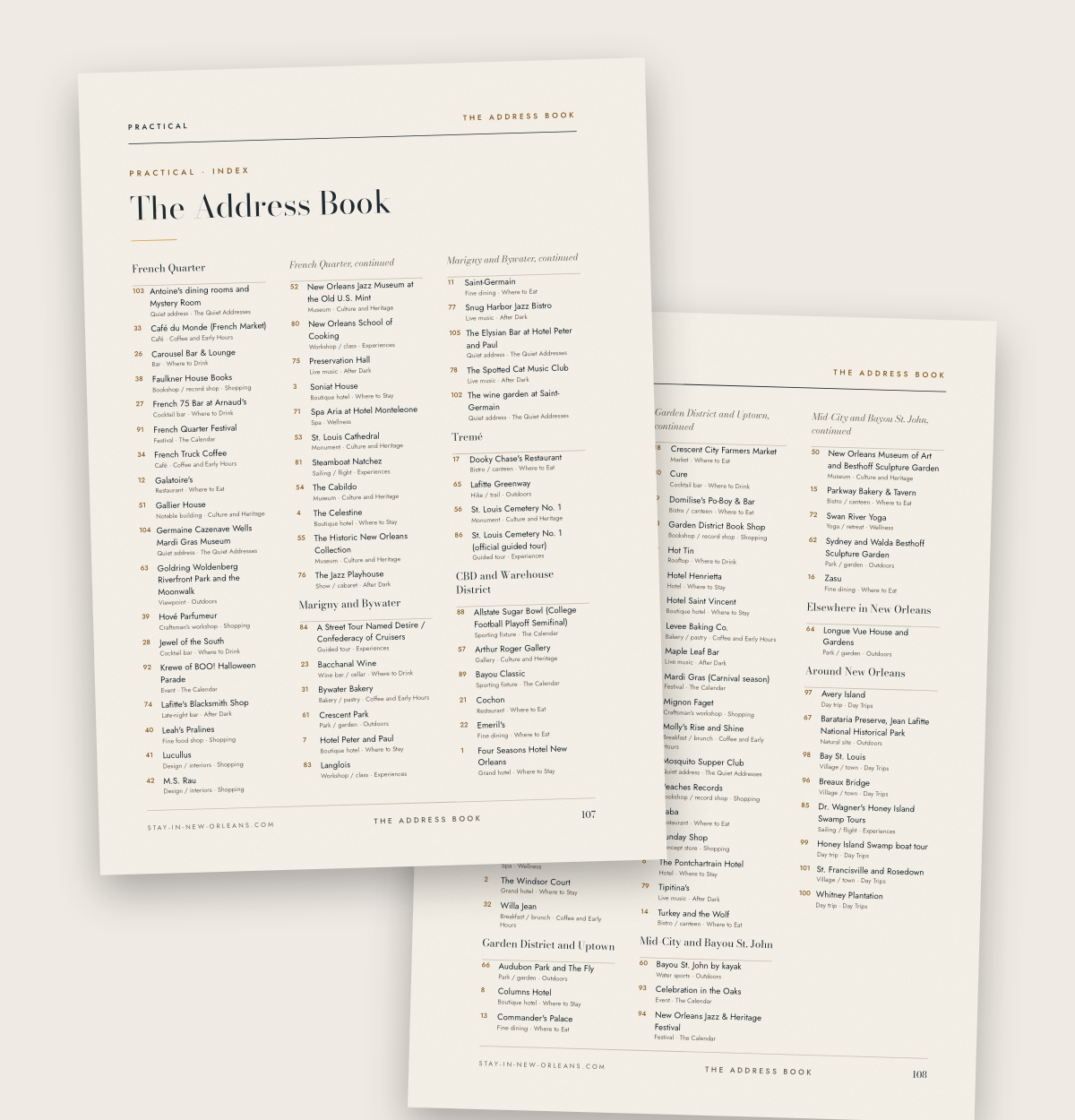
The guide closes on that index: the 106 addresses listed neighbourhood by neighbourhood, each with its number, its category and its chapter. The New Orleans City Guide is free and opens in the browser. Its page, just below, gives access to the full 2026 edition.